Indirect Immunofluorescence Assays (IFA)
The Gold Standard in Autoimmune Screening.
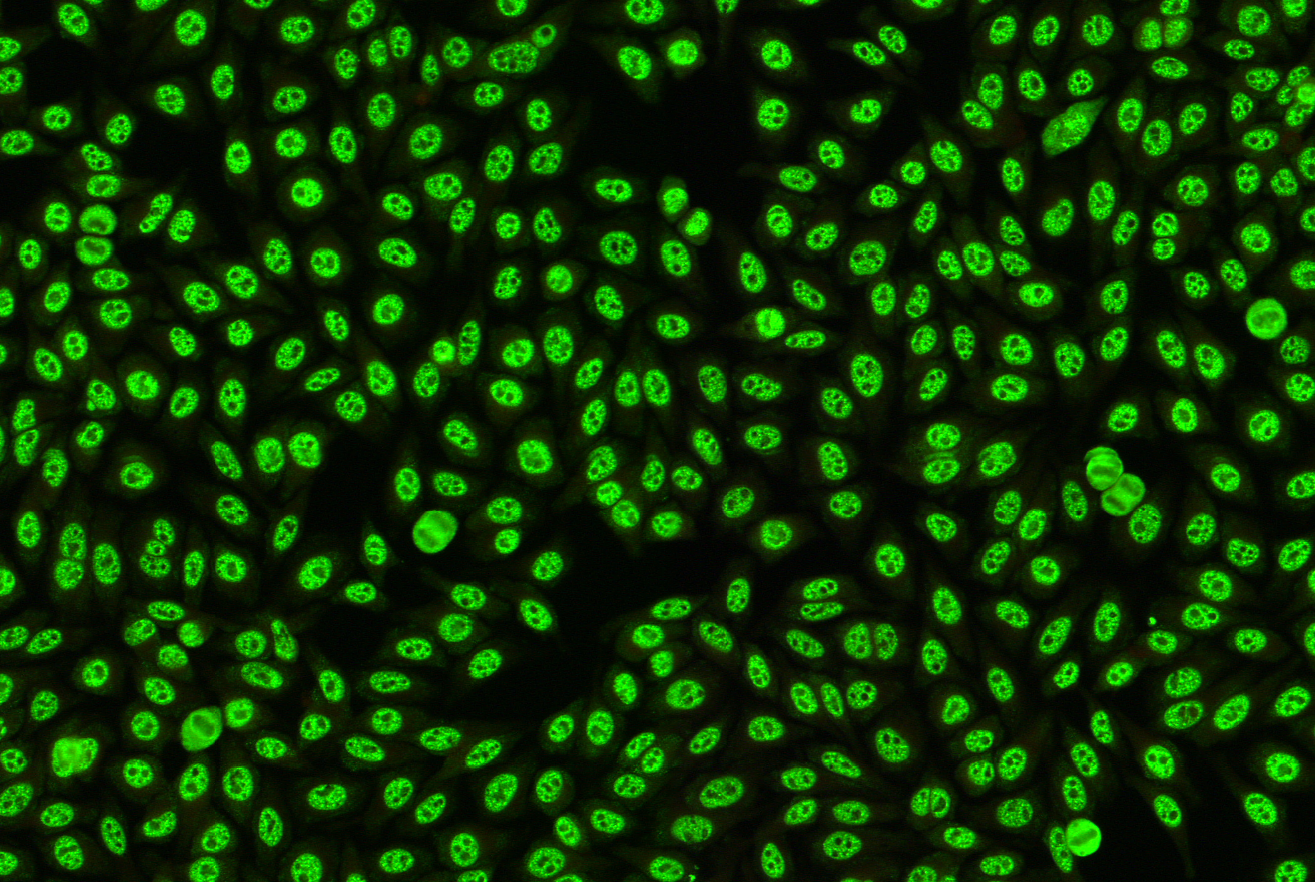
The Indirect Immunofluorescence assays (IFA) play a key role in the detection and measurement of autoantibodies. They combine immunological principles with fluorescence microscopy to provide highly specific and sensitive results. Indirect immunofluorescence is commonly used to detect autoantibodies in patients with conditions such as systemic lupus erythematosus (SLE) and Sjögren’s disease among many others. It's considered the gold standard for the detection of antinuclear antibodies (ANA) in patient's with suspected Systemic Autoimmune Disorder (SARD).
About Indirect Immunofluorescence Assays (IFA)
In an Indirect Immunofluorescence assay, patient serum is incubated with substrate-bound antigens on a slide. If specific autoantibodies are present, they bind to the antigens. Fluorescently labeled secondary antibodies are added, which attach to the autoantibodies.
Under a fluorescence microscope, the secondary antibodies emit light when exposed to specific wavelengths. The resulting patterns reveal the presence of autoantibodies and aid disease diagnostics.
Some pathologies available on IFA
Our instruments using IFA Technology
No content available.
Knowledge & Science
No content available.
Learn more about our unique technologies
Efficient, reliable, and flexible for optimized patient care.
Most standardized technology for antibody detection.
High-sensitivity technology for rapid results.
Sebia is the worldwide leader in capillary electrophoresis, delivering fully automated, high-resolution protein separation.
Comprehensive menu with high-quality results on Agarose gel.
Cette section contient des informations destinées à une large diffusion et peut donc comporter des détails sur des produits ou des informations qui ne sont pas disponibles ou valables dans votre pays. Veuillez contacter votre représentant Sebia local. Informations destinées aux professionnels de santé. Lisez attentivement les instructions figurant dans les notices des réactifs et les manuels d'utilisation des instruments.