Sebia Service
Support: We strive to provide the best-in-class service for our high-quality products. Our commitment is to support our partners and to impart our expertise and solutions. A Sebia team is committed to train, follow up, and share the knowledge for us to provide the best customer service for our customers.
Training: Solutions to suit your needs. Our partners are trained at Sebia’s Head Office (southern Paris). We also have the flexibility to offer remote e-learning, live demonstrations and instructions, self-learning videos, always assisted by experienced Sebia trainers.
Global Service Group
Global Service Group include mainly two entities:
- The Global Instrument Support department with their expertise on our systems (hardware & software).
- The Knowledge Center department with the expertise on the operation of the instruments and the reagents as well as on scientific interpretations of the results.
+20
service trainings/year
+1,500
engineers trained in 120+ countries
+60
scientific trainings/year
+1,200
customers trained in 120+ countries
Global Instrument Support (GIS)
- System training:
The GIS team provides training sessions for our Subsidiaries and Distributors.
Once qualified, the service representative’s journey starts by joining a training session.
Online, or face-to-face at a Sebia facility, the service representative will follow traditional training courses and hands-on sessions, enabling trainees to be self-sufficient in managing device operations.
After their validation qualification, engineering documentation is available in a dedicated support website: Sebia Service Portal.
Sebia training facilities are also located in: Brazil, France (HQ), Singapore, United Arabs Emirates, USA.
Languages spoken: English, Spanish, French, Arabic, Thai, Korean.
- System support:
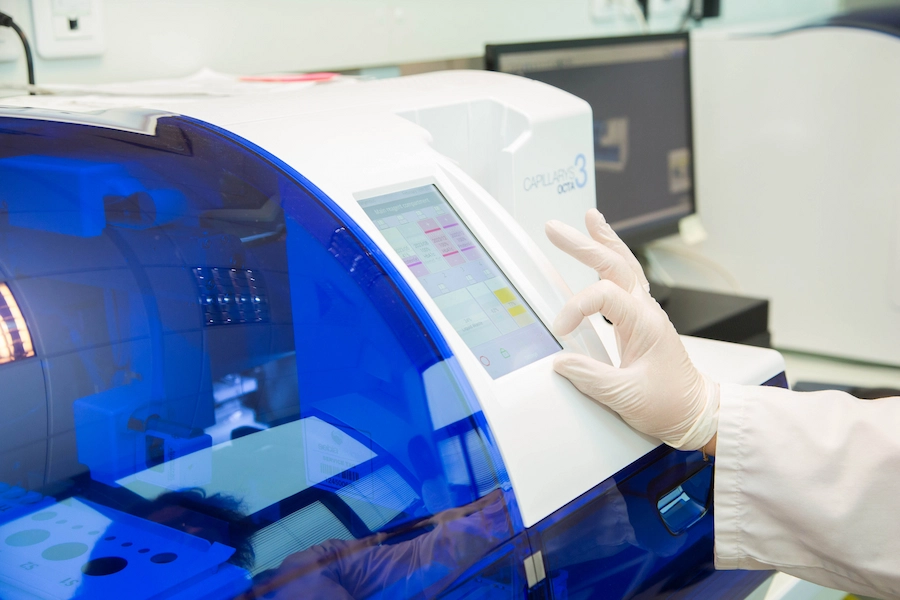
End-user support is provided by each local subsidiaries/distributors service team, performing:
- Preventive maintenance, repairs and calibration in accordance with recommended factory procedures
- Analyze, isolate and correct any operator or product malfunction together with the Knowledge Center team on a dedicated case
- Software and hardware updates
- Instruct users to safely operate and maintain their instruments
GIS team is collaborating with the local service teams on escalated cases and on daily specific operations.
GIS team is also involved in all complex installation of automation in project mode for coordination.
Webinars are organized on a regular basis with local referent on technical updates.
Worldwide service support is distributed among 5 geographic areas: APAC, Europe & Africa, LATAM, Middle East, USA.
Knowledge Center (KNC)
- System training:
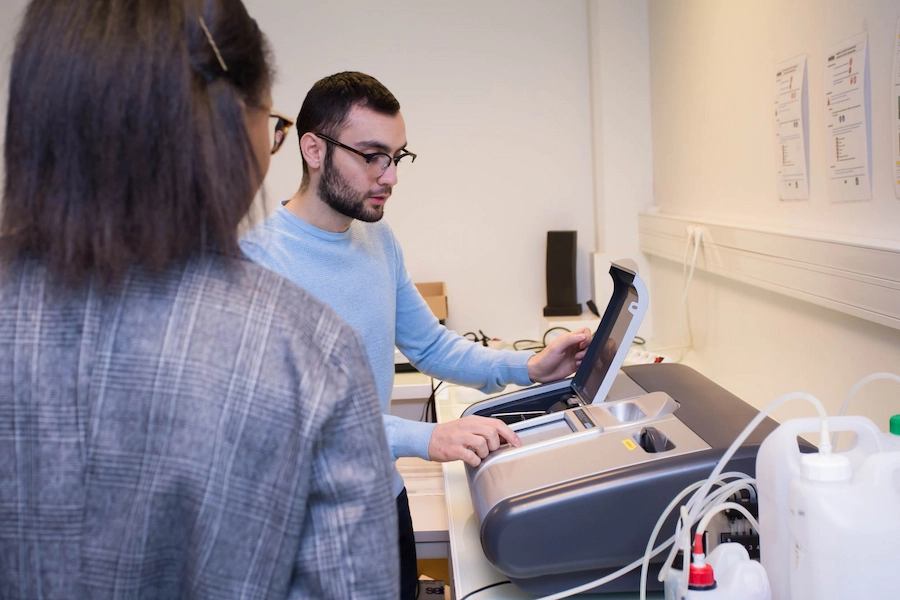
The Knowledge Center team provides application training sessions for Subsidiaries and Distributors.
Training is required for the entire Sebia product line, specific for the different pathologies covered by our IVD tests.
The sessions are dedicated to application specialists to provide them with complete knowledge on instrument and reagent handling, as well as on result interpretation and troubleshooting.
Trainings sessions (in English) can be face-to face at Sebia facilities, or online.
At the end of the training courses, trainees are evaluated to check their skills. All the presentations used during the training sessions are available on the Sebia Service Portal, updated on a regular basis.
Languages spoken: English, Spanish, French, Russian, Arabic.
- System support:
The Knowledge Center team is collaborating with the local subsidiaries/distributors application specialists when they are faced with the following:
- Complaints regarding Sebia kits
- Non optimal use of Sebia techniques and products
- Complex interpretation of the results
- Complex scientific requests