Select Your Region

We noticed you visit this page from United States. Please select your preferred region to continue

skip to content

Country Selector

Based on your location

Europe

North America

Latin America

Asia-Pacific

von Willebrand Disease

A bleeding disorder of genetic origin, or sometimes acquired, that affects blood clotting.

Von Willebrand disease (VWD) is a genetic bleeding disorder caused by a deficiency or dysfunction of von Willebrand factor (VWF), a key protein involved in blood clotting. VWF is a multimeric protein that enables platelets to adhere to and aggregate at sites of blood vessel injury. It also binds to factor VIII and forms a crucial bridge between platelet receptors and exposed subendothelial collagen, supporting the formation of an effective clot.

Published date: 3/8/2021 | Modified date: 6/4/2026

What is von Willebrand Disease (VWD)?

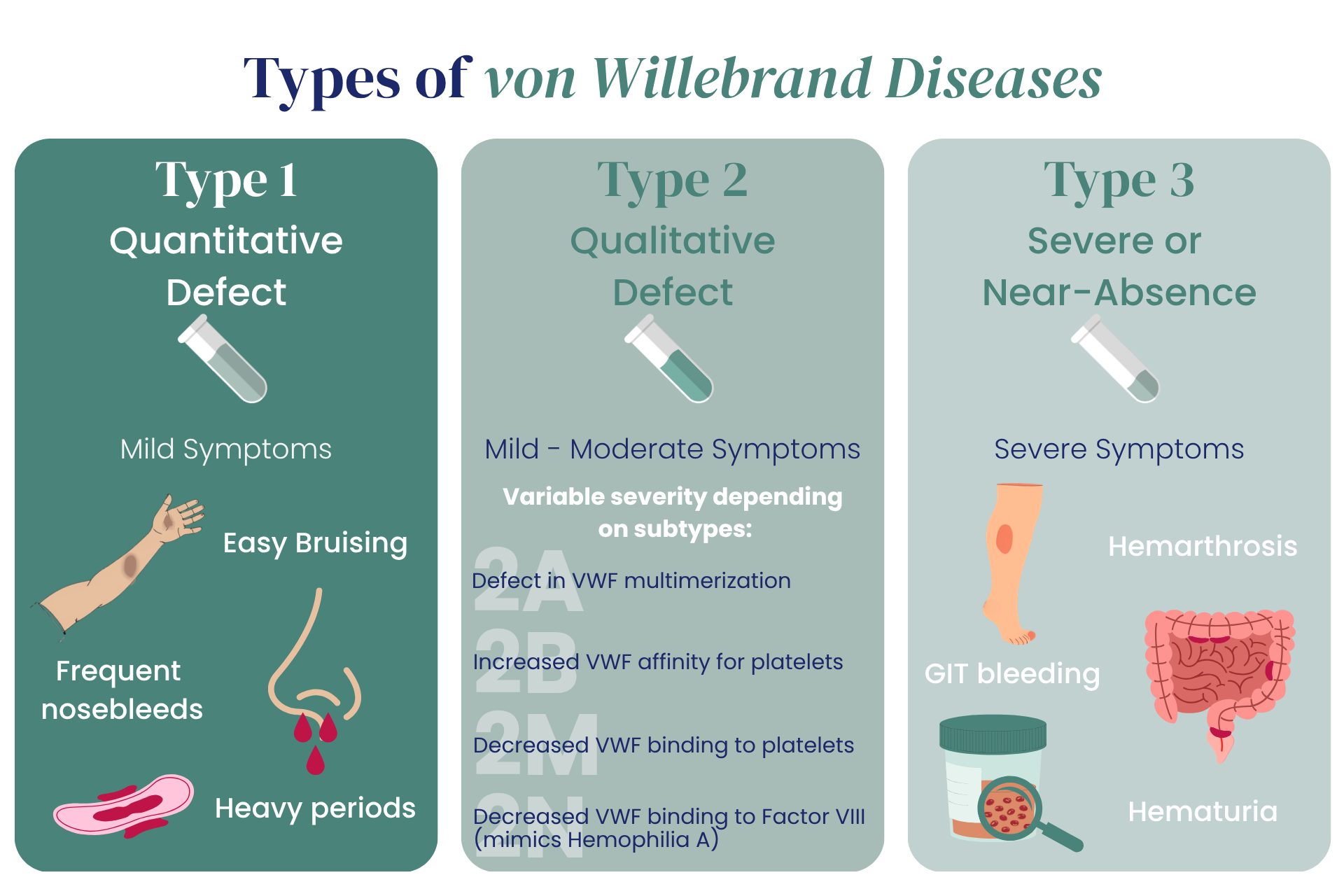
Von Willebrand disease (VWD) is classified into three major types:

  • Type 1 involves a partial quantitative deficiency of functionally normal von Willebrand factor (VWF), whereas Type 3 is characterized by a complete absence of VWF.
  • Type 2 VWD results from qualitative defects in VWF, leading to a disproportionate reduction in VWF activity compared with VWF antigen levels (VWF:Ag). This type is further subdivided into 2A, 2B, 2M, and 2N, based on the specific functional abnormalities of the protein.
  • A separate category, acquired von Willebrand syndrome, is not hereditary. It typically develops in adults in association with autoimmune diseases, certain cardiac conditions, some cancers, or other underlying medical disorders.

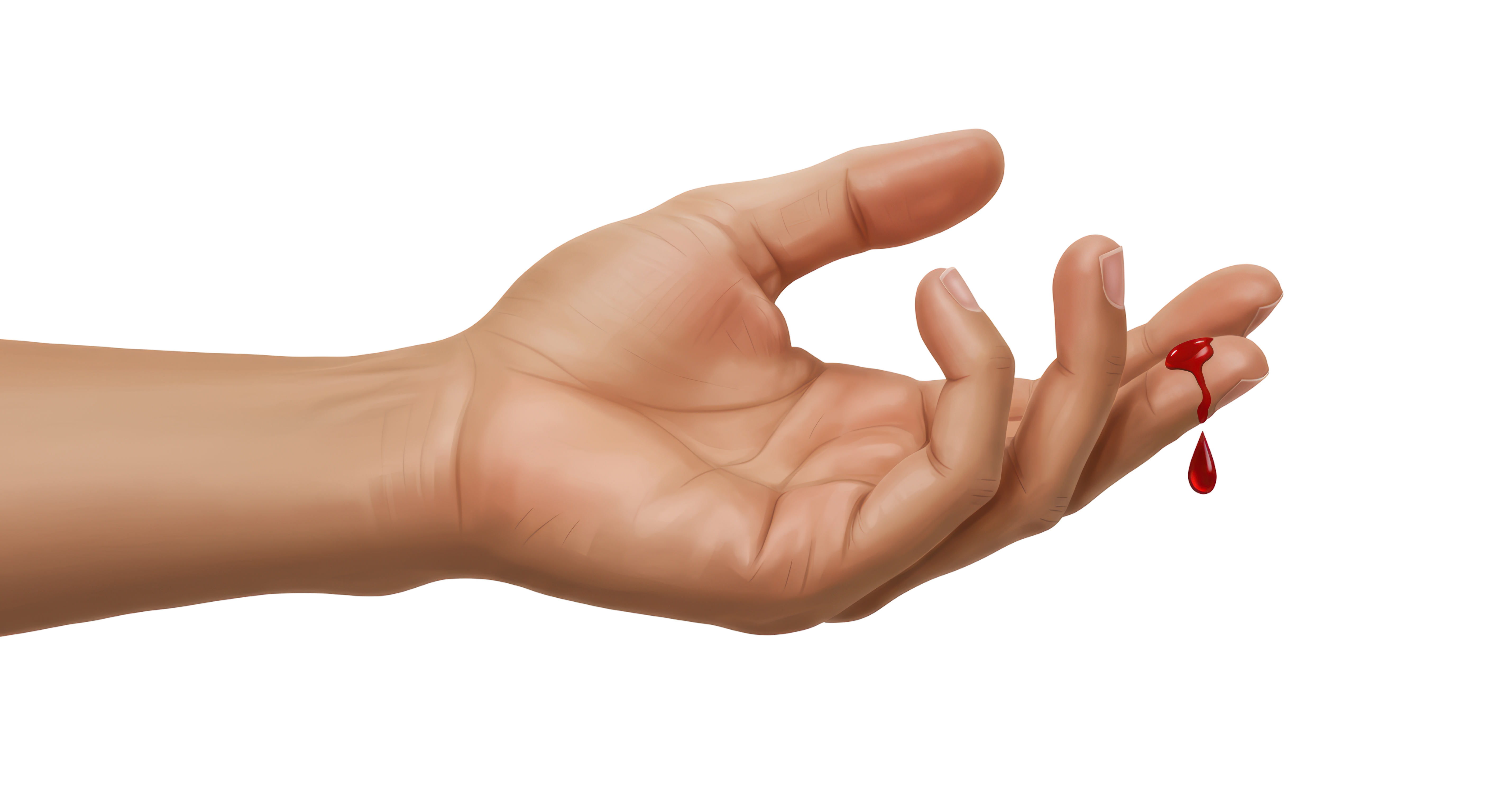
People with von Willebrand disease (VWD) often experience frequent nosebleeds, easy bruising, and prolonged bleeding during or after invasive procedures such as dental extractions or surgery. Women may have heavy and extended menstrual bleeding, as well as excessive bleeding following childbirth.

Selecting the appropriate treatment depends on the specific VWD subtype and the severity of the condition.

Von Willebrand Disease cannot be cured, but effective treatments and self‑care help most people lead active lives. Accurate subtype diagnosis is essential for guiding optimal management.

Key figures

  • About 1%

    of the population is affected by VWD, and it occurs equally in men and women

  • 1/10k

    individuals with VWD show symptoms

  • 16 years

    is the average time from first bleeding symptoms to diagnosis

How do we diagnose von Willebrand Disease?

  • Item 1

    The diagnosis and subtyping of VWD require a combination of specialized assays. Among them, VWF multimer analysis is the only method capable of detecting abnormalities in multimer distribution, which is essential for accurate VWD subtyping and for identifying the etiology of acquired VWD. Using electrophoretic protein separation, VWF multimers are classified by molecular weight into low (LMWM), intermediate (IMWM), and high molecular weight multimers (HMWM). The luminographic VWF multimer technique in agarose gels and on nitrocellulose membranes is considered the gold standard for VWD diagnosis. However, traditional multimer analysis performed on homemade gels remains time‑consuming, technically demanding, non‑standardized, and available only in a limited number of specialized laboratories.

    Item 1

Knowledge & Science

No content available.

Tests for diagnosing von Willebrand Disease

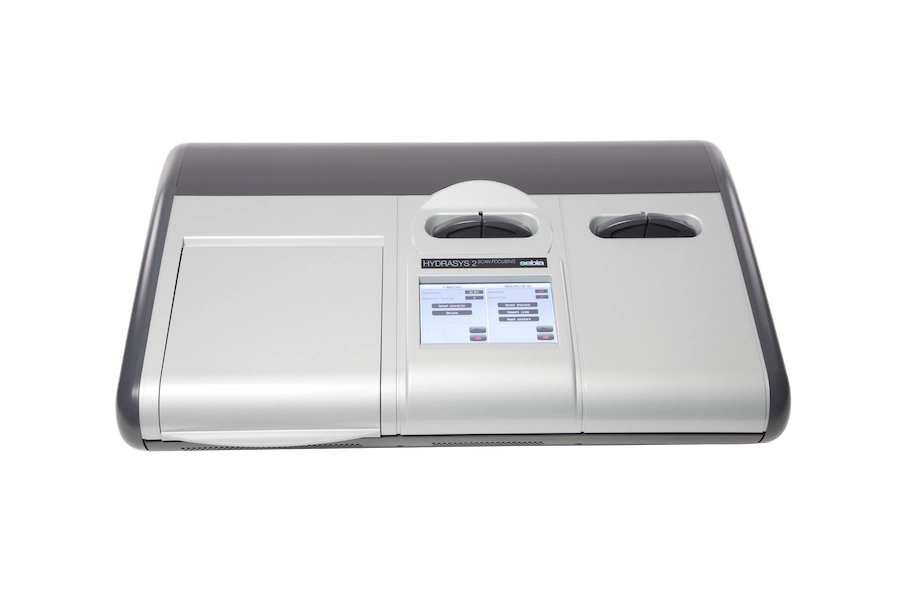
Instruments for diagnosing von Willebrand Disease

a) Data and Statistics on von Willebrand Disease - U.S. Centers for Disease Control and Prevention (CDC)

b) Schneppenheim R, Plendl H, Budde U. Luminography--an alternative assay for detection of von Willebrand factor multimers. Thromb Haemost. 1988 Oct 31;60(2):133-6. PMID: 3064356.

c) Budde U, Schneppenheim R, Plendl H, Dent J, Ruggeri ZM, Zimmerman TS. Luminographic detection of von Willebrand factor multimers in agarose gels and on nitrocellulose membranes. Thromb Haemost. 1990 Apr 12;63(2):312-5. PMID: 2363131.

d) Sadler JE, Budde U, Eikenboom JC, Favaloro EJ, Hill FG, Holmberg L, Ingerslev J, Lee CA, Lillicrap D, Mannucci PM, Mazurier C, Meyer D, Nichols WL, Nishino M, Peake IR, Rodeghiero F, Schneppenheim R, Ruggeri ZM, Srivastava A, Montgomery RR, Federici AB; Working Party on von Willebrand Disease Classification. Update on the pathophysiology and classification of von Willebrand disease: a report of the Subcommittee on von Willebrand Factor. J Thromb Haemost. 2006 Oct;4(10):2103-14. doi: 10.1111/j.1538-7836.2006.02146.x. Epub 2006 Aug 2. PMID: 16889557.

e) Pikta M, Zemtsovskaja G, Bautista H, Nouadje G, Szanto T, Viigimaa M, Banys V. Preclinical evaluation of a semi-automated and rapid commercial electrophoresis assay for von Willebrand factor multimers. J Clin Lab Anal. 2018 Jul;32(6):e22416. doi: 10.1002/jcla.22416. Epub 2018 Feb 17. PMID: 29453814; PMCID: PMC6816851.

f) Pikta M, Vasse M, Smock KJ, Moser KA, van DM, Lejniece S, Szanto T, Bautista H, Nouadje G, Banys V. Establishing reference intervals for von Willebrand factor multimers. J Med Biochem. 2022 Feb 2;41(1):115-121. doi: 10.5937/jomb0-31941. PMID: 35431650; PMCID: PMC8970582.

g) Peronino C, Rivet N, Itzhar-Baikian N, Philippe A, Joly BS, de Bezieux JR, Martin AC, Luneau S, Veyradier A, Gaussem P, Gendron N, Smadja DM. Évaluation d’un test semi-automatisé de quantification des multimères du facteur von Willebrand [Evaluation of a semi-automated test for quantification of von Willebrand multimers]. Ann Biol Clin (Paris). 2024 Sep 19;82(4):361-375. French. doi: 10.1684/abc.2024.1903. PMID: 39210589.

This section contains information intended for wide distribution and may therefore contain product details or information that is not available or valid in your country.

Please contact your local Sebia representative. Information intended for healthcare professionals.
Carefully read the instructions in the reagent package inserts and instrument manuals.