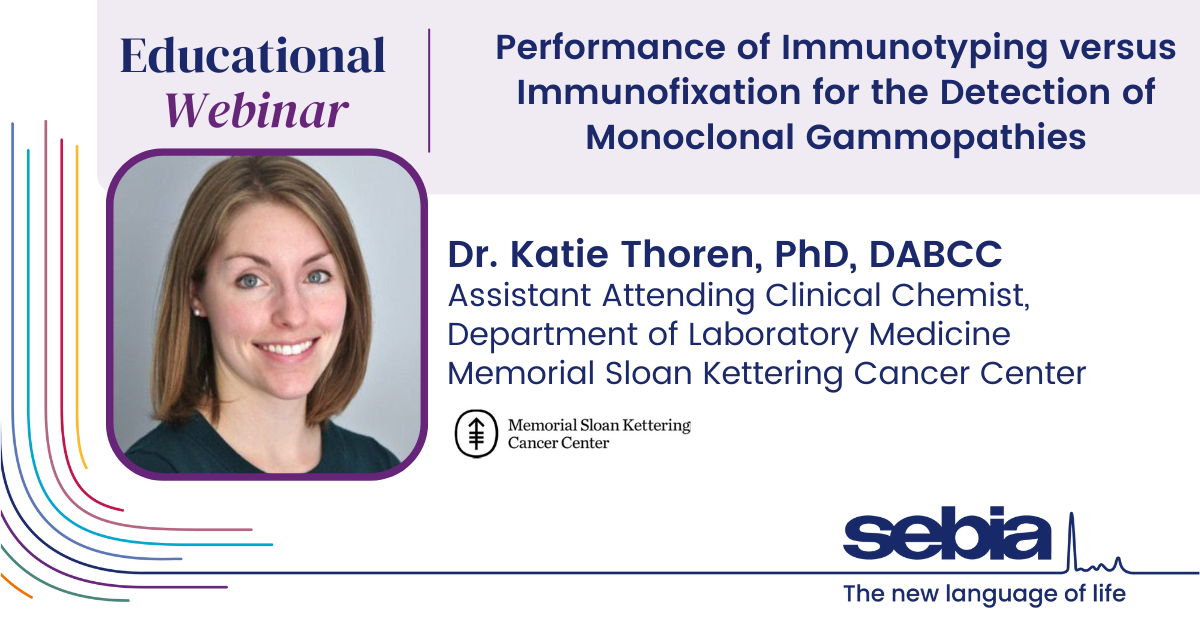
Compare immunotyping and immunofixation for M-protein detection
Understand the similarities and differences in performance between IT and IF for identifying and characterizing monoclonal proteins.

This webinar is presented in English.

Serum immunofixation (IF) is routinely used in clinical laboratories to confirm the presence of an M-protein and determine its isotype. For laboratories looking for more of an automated method for the detection of M-proteins, immunotyping (IT) by capillary electrophoresis is also FDA-approved to confirm the presence of M-proteins and determine its isotype.
In this webinar, Dr. Katie Thoren will discuss a recent study comparing the performance of immunotyping to immunofixation for the detection of M-proteins. She will show that reviewer training and experience are critical to the correct interpretation of IT results and that the analytical and clinical sensitivity is similar to IF for the detection of M-proteins. Dr. Thoren will present the data, review the limitations of each test and discuss potential strategies for mitigating these limitations.
Understand the similarities and differences in performance between IT and IF for identifying and characterizing monoclonal proteins.
Learn how experience and training influence the accuracy and reliability of immunotyping result assessment.
Review the analytical and clinical considerations of IT and IF, including potential limitations and mitigation strategies for routine laboratory practice.
Training is really critical to the sensitivity of immunotyping

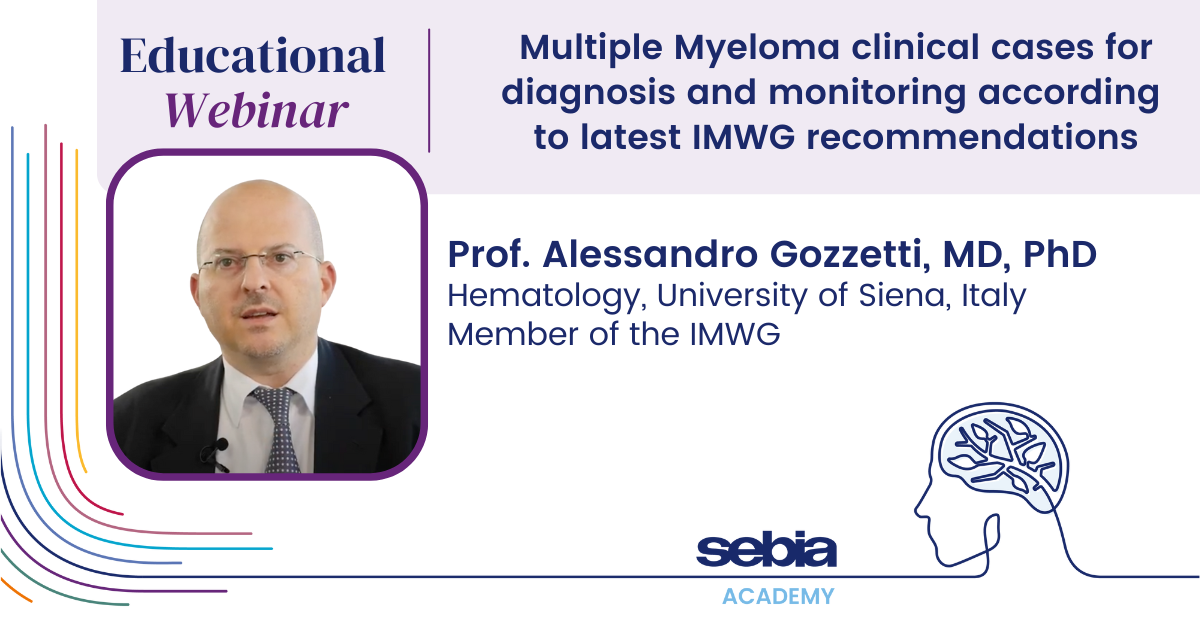
Educational Webinar with Prof. Alessandro Gozzetti, MD, PhD
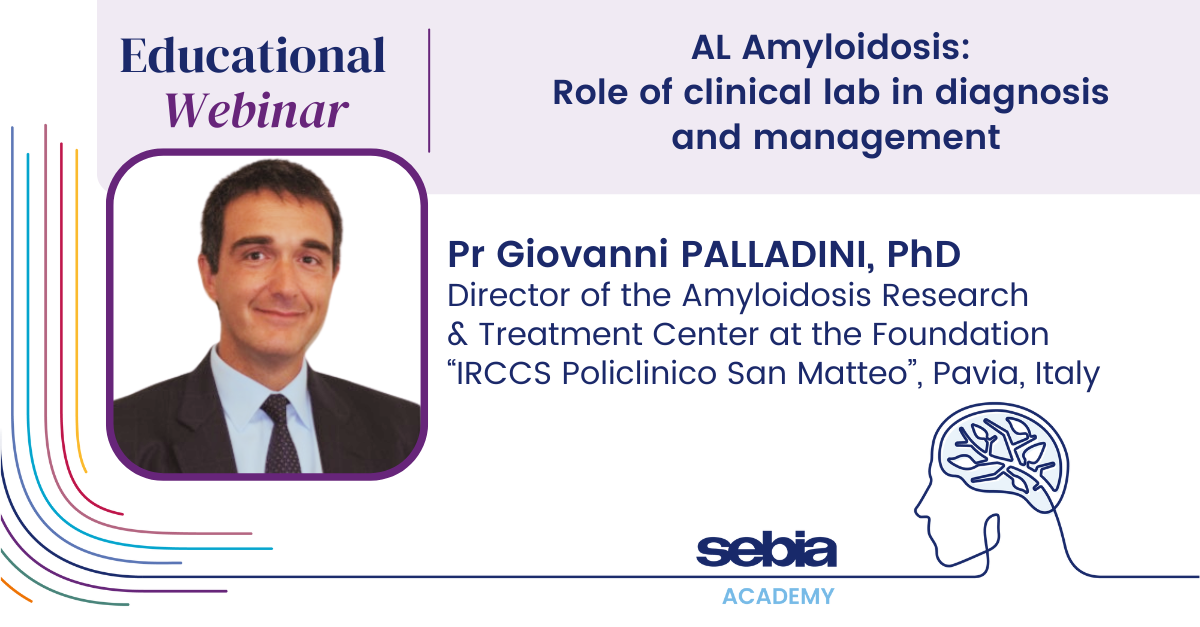
Educational Webinar with Prof. Giovanni PALLADINI, PhD
Educational Webinar with Katie Thoren, PhD
This section contains information intended for wide distribution and may therefore contain product details or information that is not available or valid in your country. Please contact your local Sebia representative. Information intended for healthcare professionals. Carefully read the instructions in the reagent package inserts and instrument manuals.